Closing the Loop: Leadership Feedback as a Weekly System
Upward clarity compounds when context returns the other way.
1. Why This Exists
Most companies report up, not back down.
Teams share updates, leadership reviews in silos, and feedback often disappears into the void.
The result? Context drift, slower decisions, and teams operating without clear reinforcement.
This prototype completes the loop — turning one-way reporting into a compound rhythm of feedback and clarity.
2. Building on the BizOps Briefing
Two weeks ago, I shared the Automated BizOps Briefing — a system for surfacing weekly updates from teams into a synthesized executive summary.
That solved the upward flow of information.
But it left one question open:
How does leadership consistently respond, clarify, and reinforce direction?
This iteration introduces the Leadership Feedback Layer — a structured way for executives to respond and close the loop each week.
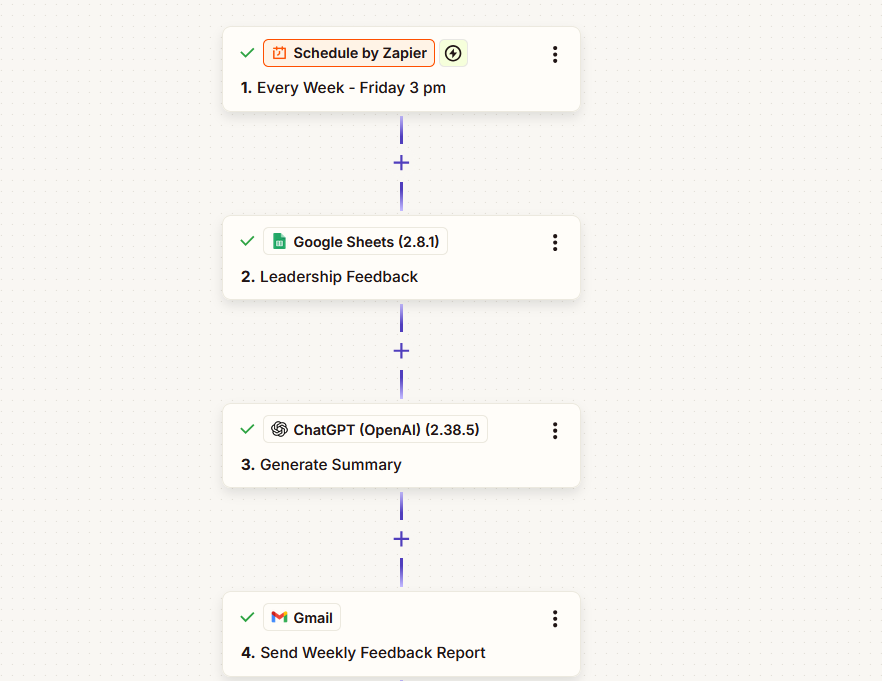
3. System Flow Overview
Below is the same BizOps Briefing flow, extended with a new downward feedback path.
Each component now reinforces the next, creating a continuous information cycle.
Flow Steps:
- Team Updates → Collected automatically via the cross-functional Google Sheet.
- Synthesis → The Automated BizOps Briefing summarizes themes.
- Leadership Feedback → Executives respond to the briefing through a structured form.
- Redistribution → Feedback flows back down to teams in the next cycle.
- Compounding Loop→ Over time, clarity and alignment reinforce themselves.

4. Leadership Feedback Form
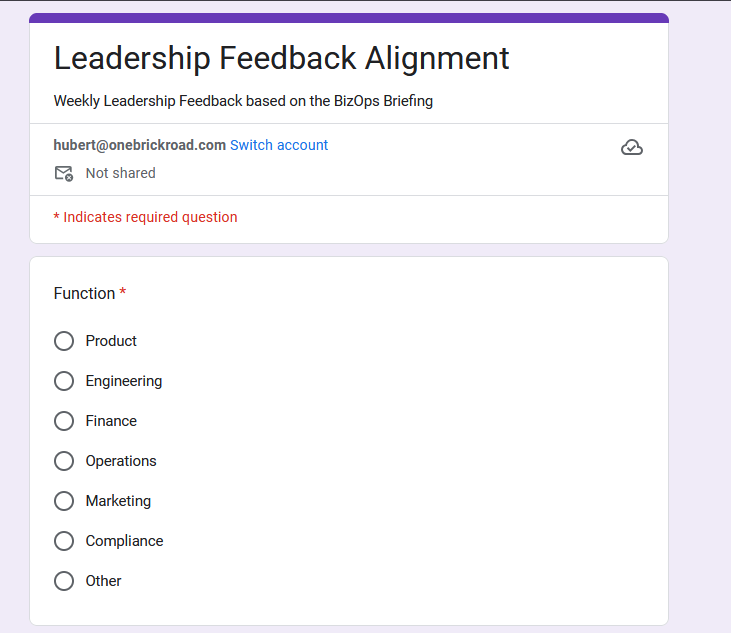
To make leadership responses consistent and actionable, I designed a lightweight weekly form.
This provides structure without friction — 7 questions that translate executive intent into team clarity.
Leadership Feedback Form – Weekly Inputs
Identification
- Function (Dropdown)
- Product
- Engineering
- Finance
- Operations
- Marketing
- Compliance
- Leadership Team
- Other
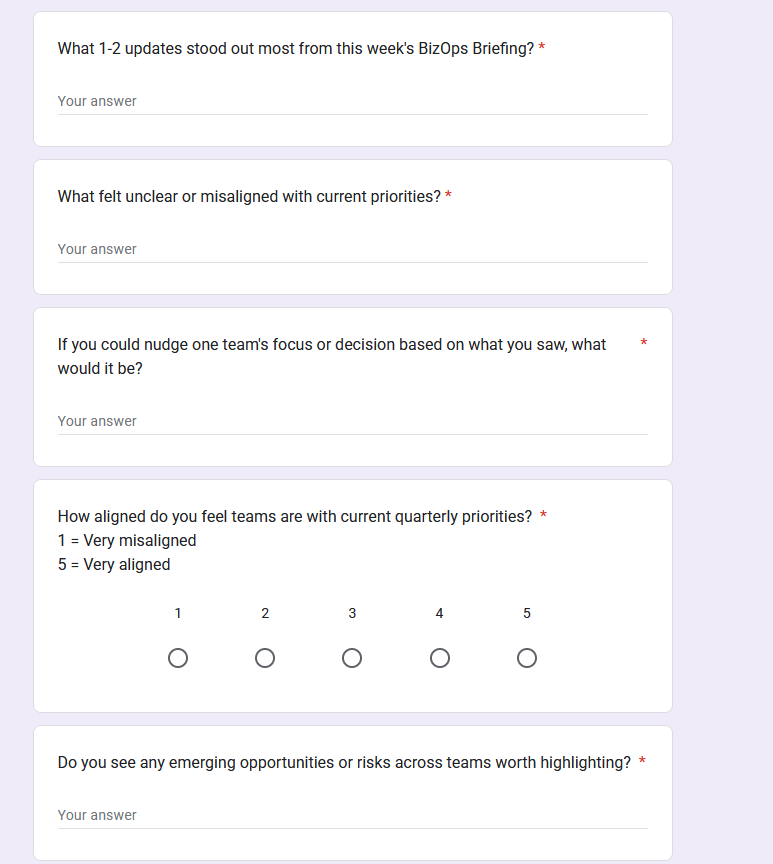
Reflections on This Week’s Briefing
1. What 1–2 updates stood out most from this week’s BizOps Briefing?
(Paragraph)
2. What felt unclear or misaligned with current priorities?
(Paragraph)
3. If you could nudge one team’s focus or decision based on what you saw, what would it be?
(Paragraph)
Strategic Alignment Signals
4. How aligned do you feel teams are with current quarterly priorities?
(Linear scale 1–5)
- 1 = Very misaligned
- 5 = Very aligned
5. Do you see any emerging opportunities or risks across teams worth highlighting?
(Paragraph)
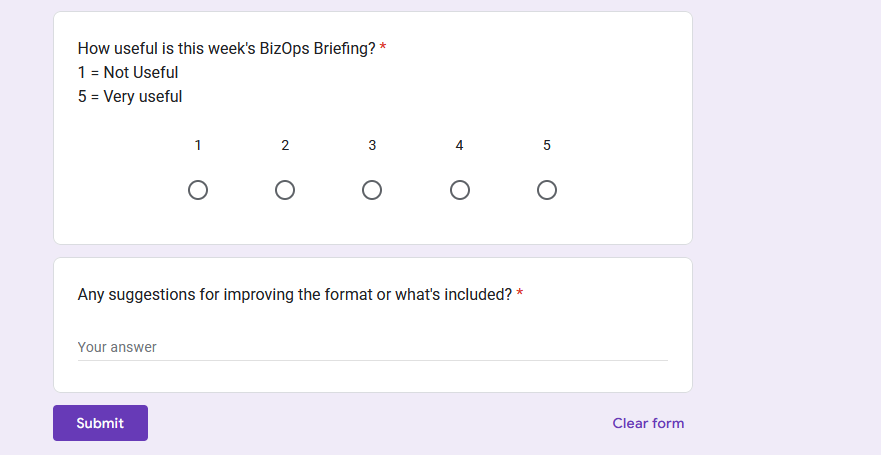
Form Improvements
6. How useful was this week’s BizOps Briefing?
(Linear scale 1–5)
- 1 = Not useful
- 5 = Very useful
7. Any suggestions for improving the format or what’s included?
(Paragraph)
5. The Compound Effect
This isn’t just a form — it’s a rhythm.
A single cycle happens within the same week, and the clarity compounds week over week.
Within-Week Cadence (One Cycle)
1. Upward updates — Teams surface insights
2. Leadership review — Signals are synthesized
3. Downward feedback — Context flows back to teams
4. Iterate & commit — Shared understanding deepens
Over Multiple Weeks (Compounding)
- Week N: Loop closes → decisions + next experiments.
- Week N + 1: Better inputs, faster feedback, tighter scope.
- Week N + 2 ... : The rhythm becomes institutional — the organization learns from itself.
Once loops start closing, clarity compounds.
6. Why It Matters
High-performing organizations don’t just communicate — they engineer operating clarity.
A well-structured leadership feedback loop creates a self-correcting system for alignment and execution:
- Prevents strategic drift. Keeps daily priorities tethered to leadership intent.
- Transforms reaction into rhythm. Replaces status churn with predictable feedback cycles.
- Builds trust through transparency. Everyone sees how decisions are made and acted on.
- Reduces coordination overhead. Fewer meetings, faster context transfer.
- Improves decision velocity. Teams adapt within days, not quarters.
No new software required — just intentional structure, consistent cadence, and a shared commitment to learning faster than the work changes.
Brick by brick,
Hubert